Measurement Techniques for Engagement Ring Sizes Explained Clearly
Understanding Ring Sizes: Basics and Averages
Knowing how engagement ring sizes work is the first step to getting the perfect fit. Ring sizes are typically measured by the circumference of the finger in millimeters (mm). In the US, sizes are given as numbers—commonly between 5 and 7 for women and 10 to 11 for men. The UK, on the other hand, uses letters (like J, K, L) to mark sizes.
Here’s a quick overview:
- Measurement units: Circumference in millimeters, US numerical scale, UK letters.
- Average sizes: Women usually wear US sizes 5 to 7; men typically wear sizes 10 to 11.
- Size variations: Finger size isn’t constant and can change due to several factors:
- Temperature: Fingers swell in heat and shrink in cold.
- Time of day: Fingers are often larger in the evening.
- Dominant hand: The hand you use most tends to be slightly bigger.
- Knuckle vs. base: Sometimes the knuckle is wider than the base of the finger, affecting fit.
Understanding these basics ensures you make informed decisions when measuring ring size for an engagement. Keep these factors in mind for more accurate results and a comfortable, lasting fit.
Professional Measurement: The Most Accurate Option
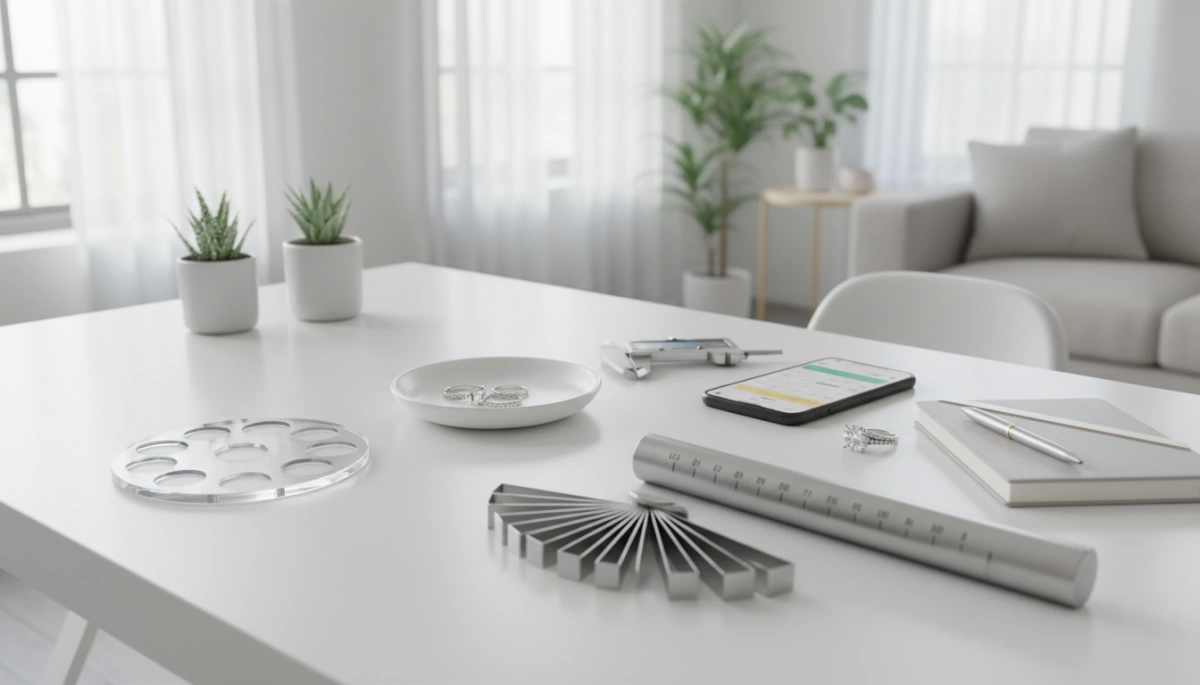
For the most accurate engagement ring size, visiting a jeweler is your best bet. Most jewelers offer a free ring sizing service using professional tools like mandrels and ring sizers, which provide precise measurements you simply can’t get at home. This is especially important if you\’re dealing with complex ring designs or wide bands, where small differences in size can impact comfort and fit.
You should measure the intended finger, typically the left ring finger for engagement rings, to ensure the best fit. Jewelers can also account for factors like knuckle size and ring shape, which is hard to do with DIY methods. If you want to avoid surprises, this professional method is a solid way to get it right from the start.
At-Home Measurement Techniques
Measuring ring size at home can be simple and surprisingly accurate if you follow the right steps. Here are some popular methods to help you find the perfect engagement ring size without visiting a jeweler.
String or Paper Method
- Cut a thin strip of paper or a piece of string.
- Wrap it snugly around the base of the intended finger (usually the left ring finger).
- Mark where the ends meet with a pen.
- Measure the length with a ruler in millimeters.
- Compare this measurement to an engagement ring size chart to find the size.
Printable Ring Size Chart
- Print a ring size chart ensuring the scale is 100% accurate (no “fit to page” adjustments).
- Place a ring that fits well on the chart, matching the inner circle.
- The circle that fits perfectly without overlapping shows the ring size.
Flexible Tape Measure or Ring Sizer Tool
- Using a flexible tape measure or a plastic ring sizer tool can be easier than string because they don’t stretch.
- Slide the tape or tool onto the finger and read the size directly.
- These tools often show sizes in both US and UK scales, offering quick conversions.
Borrowing an Existing Ring
- If you have access to a ring the wearer already owns, this is one of the best options.
- Make sure it’s from the correct finger (usually the left ring finger) and hand, since sizes can differ.
- Measure the inner diameter with a ruler or place it on the printable chart to get an accurate size.
Tips to Ensure Accuracy
- Measure the finger multiple times to confirm consistent results.
- Do the measurement at room temperature; fingers can swell or shrink depending on heat or cold.
- Try measuring in the middle of the day since fingers tend to be their average size then, avoiding early morning puffiness or evening swelling.
Using these at-home techniques, you can get a reliable engagement ring size without professional tools. Just take your time and be precise for the best result.
Secretly Measuring for a Surprise Proposal
Measuring ring size secretly is common for surprise proposals, but it’s important to be respectful and ethical about it. You want to avoid ruining the surprise while making sure the ring will fit comfortably.
Discreet Methods to Measure Ring Size
- Borrow a worn ring: Sneakily take a ring your partner already wears on their ring finger (ideally the left hand). Use the string method or a printable ring size chart to measure it.
- Enlist friends or family: Ask someone close to help with measurements or to subtly find out the size through casual conversation.
- Measure while asleep: Carefully wrap a thin string or strip of paper around the finger at night, then measure the string length in the morning.
Alternative Hacks
- Shopping trips: Casually “try on” rings together and note the size they pick. You can then discreetly remember or write it down.
- “Gift sizing” questions: Mention wanting to buy a ring for yourself or a friend and ask what size they wear, masking your real intent.
Risks and Fallbacks
Keep in mind that fingers change size depending on time of day, temperature, and dominant hand. Because of this, even the best secret measurement might not be perfect. To avoid stress, always check if the jeweler offers free ring resizing — this safety net lets you adjust the ring after the proposal if needed.
These tips make secretly measuring a lot easier while respecting your partner’s privacy, ensuring a smooth and happy surprise moment.
Ring Size Charts and International Conversions
Understanding ring size charts is key to getting the right fit, especially if you\’re buying engagement rings internationally. In the US, ring sizes are usually listed as numbers (like 5, 6, 7), and each corresponds to a specific circumference in millimeters (mm) and diameter. For example, a US size 6 typically has a circumference of around 51.9 mm and a diameter of 16.5 mm.
When shopping across borders, you’ll often need to convert ring sizes. Here’s a quick overview:
- US to UK: US sizes use numbers, UK sizes use letters (e.g. US 6 = UK L ½).
- US to Europe (EU): European sizes are measured in mm of circumference but shown as numbers without decimals (e.g. US 6 ≈ EU 52).
- Other countries sometimes have distinct systems, so using an international ring size chart helps avoid confusion.
Also, remember that band width affects ring fit. Wider bands take up more space on the finger, so it’s common to size up by half a size or even a full size for wider bands to keep the ring comfortable.
For accurate sizing, always refer to a reliable ring size conversion chart and consider how the ring’s design may change the fit. If you want a handy visual tool, you can find a printable ring sizer or look up detailed charts online that show circumference, diameter, and size conversions all in one place.
If you\’re interested in how sizing varies based on style or you want more tips on choosing the perfect fit, related resources on layering styles and personalizing your look can be helpful, like this beginner’s guide on integrating local crafts into everyday style.
Additional Considerations for Engagement Rings
Engagement rings with wider bands or intricate settings often need special attention when it comes to sizing. Wider bands can feel tighter because they cover more of your finger, so it’s usually recommended to size up slightly for comfort. Similarly, rings with raised or detailed settings may affect how the ring fits and feels, so consulting a jeweler before finalizing your size is a smart move.
If you find yourself between sizes, the safest bet is to go up a half size rather than down. This ensures the ring isn\’t too tight and can be resized if needed without much hassle. Speaking of resizing, most engagement rings made from gold, platinum, or silver can be resized, but the complexity—and cost—depends on the design. Intricate settings or pave diamonds may increase the cost or limit resizing options.
Resizing typically ranges from $50 to $150, but some jewelers offer free ring resizing within a certain time frame after purchase. Always check warranty and resizing policies upfront to avoid surprises later, especially since an engagement ring is meant to be a perfect fit!
Common Mistakes to Avoid When Measuring Engagement Ring Size
Getting the right engagement ring size can save a lot of hassle, but there are some common mistakes to watch out for when measuring at home or even at a jeweler.
- Measuring at the wrong time or day: Finger size can change throughout the day and with temperature. Avoid measuring early morning or late evening. The best time is midday when your fingers are at their average size. Also, don’t measure when your hands are cold or hot—temperature affects finger swelling.
- Using rings from different fingers or hands: Don’t guess size by using rings worn on other fingers or the opposite hand. Each finger is unique, and ring sizes often vary between hands. Borrow a ring worn on the same finger you’re trying to measure, ideally the left ring finger for engagement rings.
- Ignoring knuckle fit: Sometimes a finger’s base might be smaller than the knuckle. If the ring is for a knobbly finger, make sure to consider the knuckle’s size to avoid choosing a size that’s too tight to slide over.
Avoiding these mistakes ensures a more accurate engagement ring fit and a better experience when proposing or gifting. For more reliable sizing tips or specialized cases like wider bands, it’s always a smart move to check with a professional jeweler or use a ring sizer tool designed to capture knuckle and base measurements accurately.